
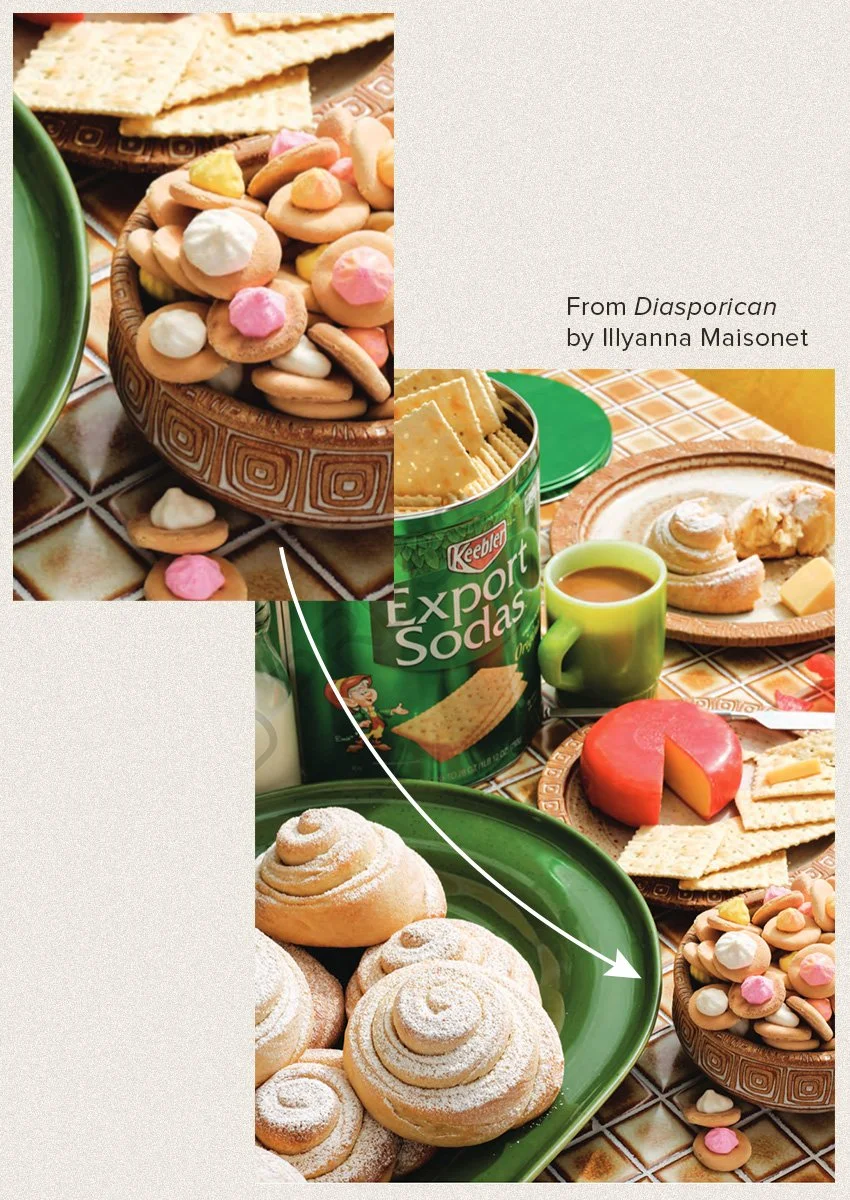
The photo from Diasporican by Illyanna Maisonet that started this whole thing.
My mom’s repertoire of Puerto Rican dishes wasn’t deep, so I bought Diasporican to experiment with other classics. While thumbing through its pages I spotted a bowl in one of the photos that I couldn’t stop thinking about. The glaze! The pattern! The beautifully imperfect, handmade finish! That one little vessel propelled me down a rabbit hole that lead to a group of ceramicists working in San Juan in the 50s and 60s that produced uniquely Puerto Rican work.
There’s so little documentation available and I’m still trying to untangle where the group “Puerto Rican Pottery,” “Isla del Sol,” and “Los Artesanos” began and ended. Regardless, how could I just now be learning about artisans who created a uniquely Puerto Rican style of pottery that people are still hunting for on sites like 1st Dibs and Chairish? After more digging, here’s what else I found:
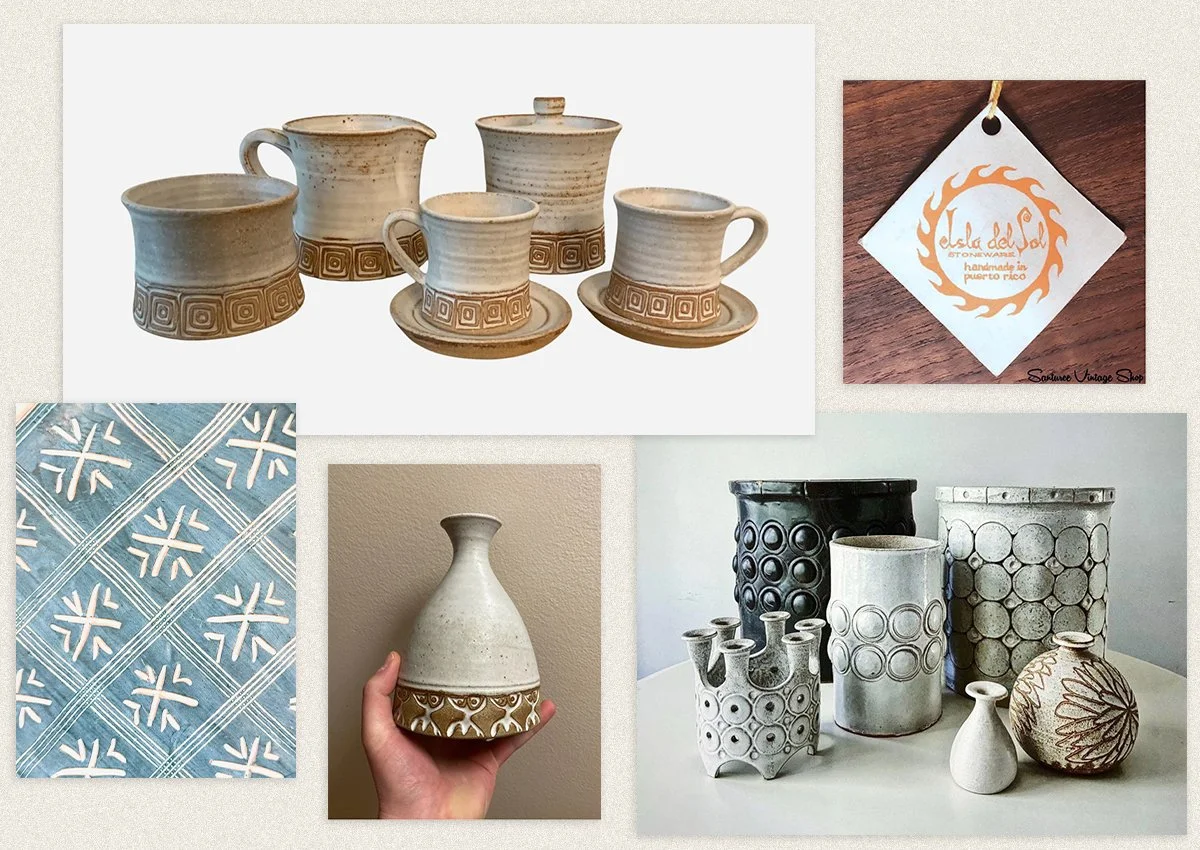
Images, starting from the top left and moving clockwise: Coffee set attributed to Los Artesanos; an original tag included with pottery by the group Isla del Sol; collection of pieces attributed to Isla del Sol; Vase attributed to Los Artesanos; Pattern detail from a dish.
A government program meant to bolster production and manufacturing in PR hired Hal Lasky to train ceramicists, some of whom went on to form different pottery groups. Lasky pushed his trainees to ditch the rote, touristy designs flooding the market and to develop their own artistic voices.
What resulted was a sgraffito technique, patterns scraped away from the clay’s surface that played with contrasting colors. As the artists’ work developed, their patterns ended up echoing more and more the petroglyphs found across the island and left by the indigenous Puerto Ricans, the Taino. The resulting pottery ended up blending mid-century design with symbols and designs intrinsic to the island’s history.
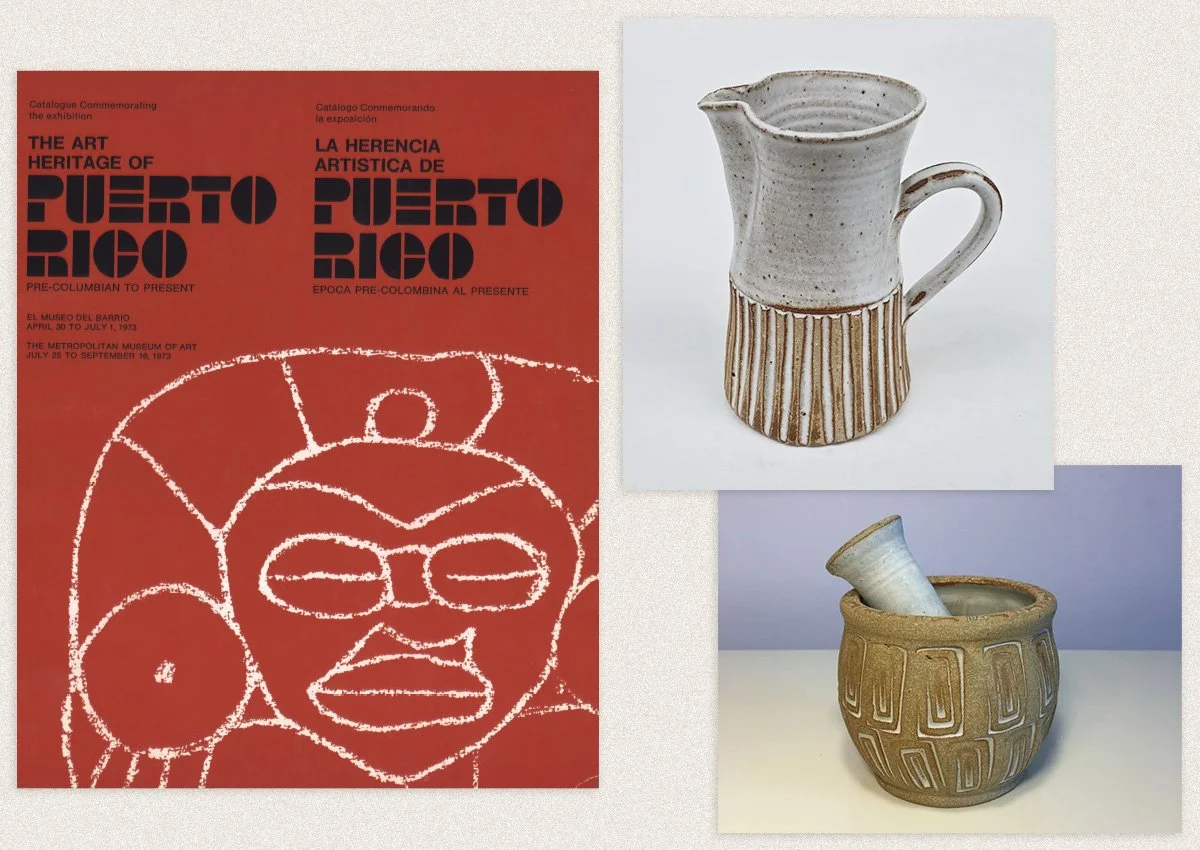
Cover of “The Art Heritage of Puerto Rico: Pre-Columbian to Present” by The Metropolitan Museum of Art and El Museo del Barrio; Pitcher attributed to Los Artesanos and Puerto Rican Pottery; Mortar and pestle, source unknown.
Each piece has a character that can only result from being worked by human hands, and the sgraffito technique meant that the results were often a surprise. I love that this blending of technique and context lead to something distinctly Puerto Rican.
The inclusion of that bowl in Diasporican feels like a deep cut, a quiet reference to the style and craftsmanship that can be found in Puerto Rico if you take the time to look hard enough.