
Sara Golden Jewelry

Culture

Puerto Rican Pottery

Inspiration, Culture, Behind the ScenesSara GoldenComment

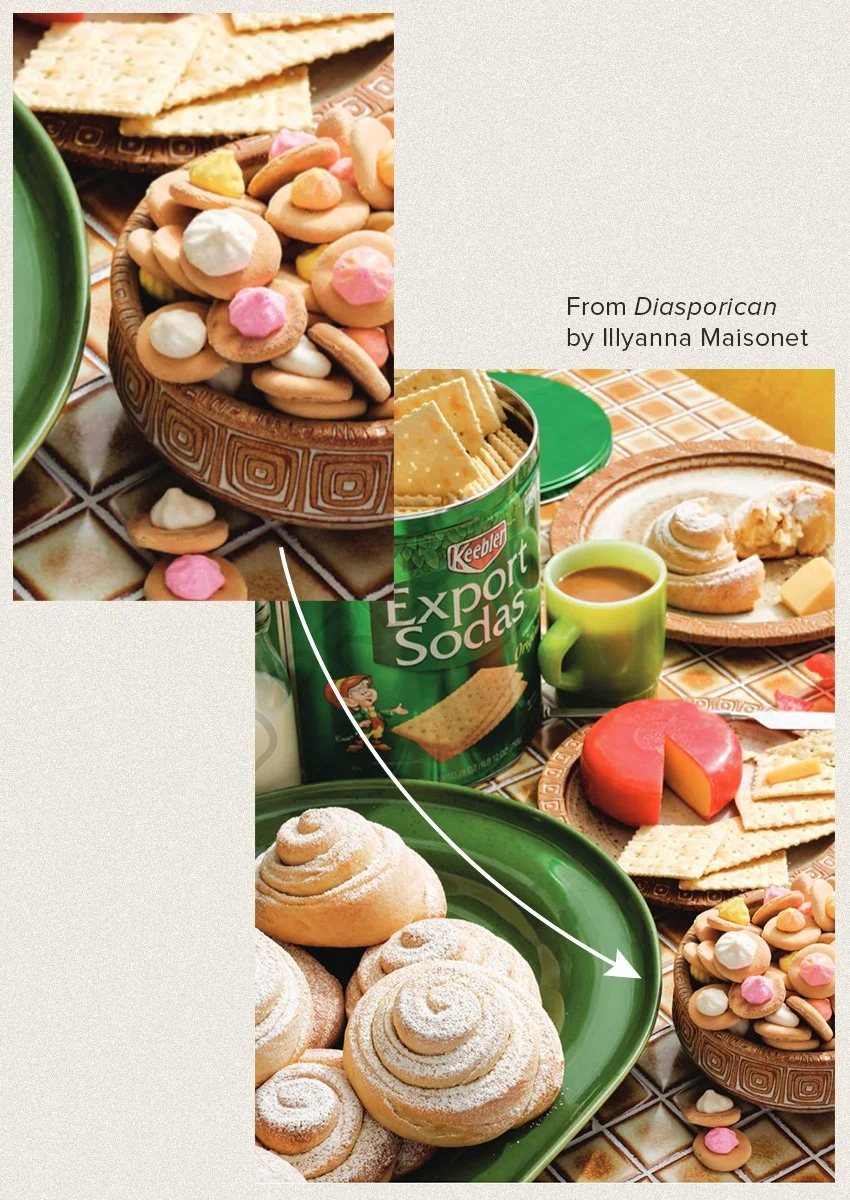
The photo from Diasporican by Illyanna Maisonet that started this whole thing.

My mom’s repertoire of Puerto Rican dishes wasn’t deep, so I bought Diasporican to experiment with other classics. While thumbing through its pages I spotted a bowl in one of the photos that I couldn’t stop thinking about. The glaze! The pattern! The beautifully imperfect, handmade finish! That one little vessel propelled me down a rabbit hole that lead to a group of ceramicists working in San Juan in the 50s and 60s that produced uniquely Puerto Rican work.

There’s so little documentation available and I’m still trying to untangle where the group “Puerto Rican Pottery,” “Isla del Sol,” and “Los Artesanos” began and ended. Regardless, how could I just now be learning about artisans who created a uniquely Puerto Rican style of pottery that people are still hunting for on sites like 1st Dibs and Chairish? After more digging, here’s what else I found:
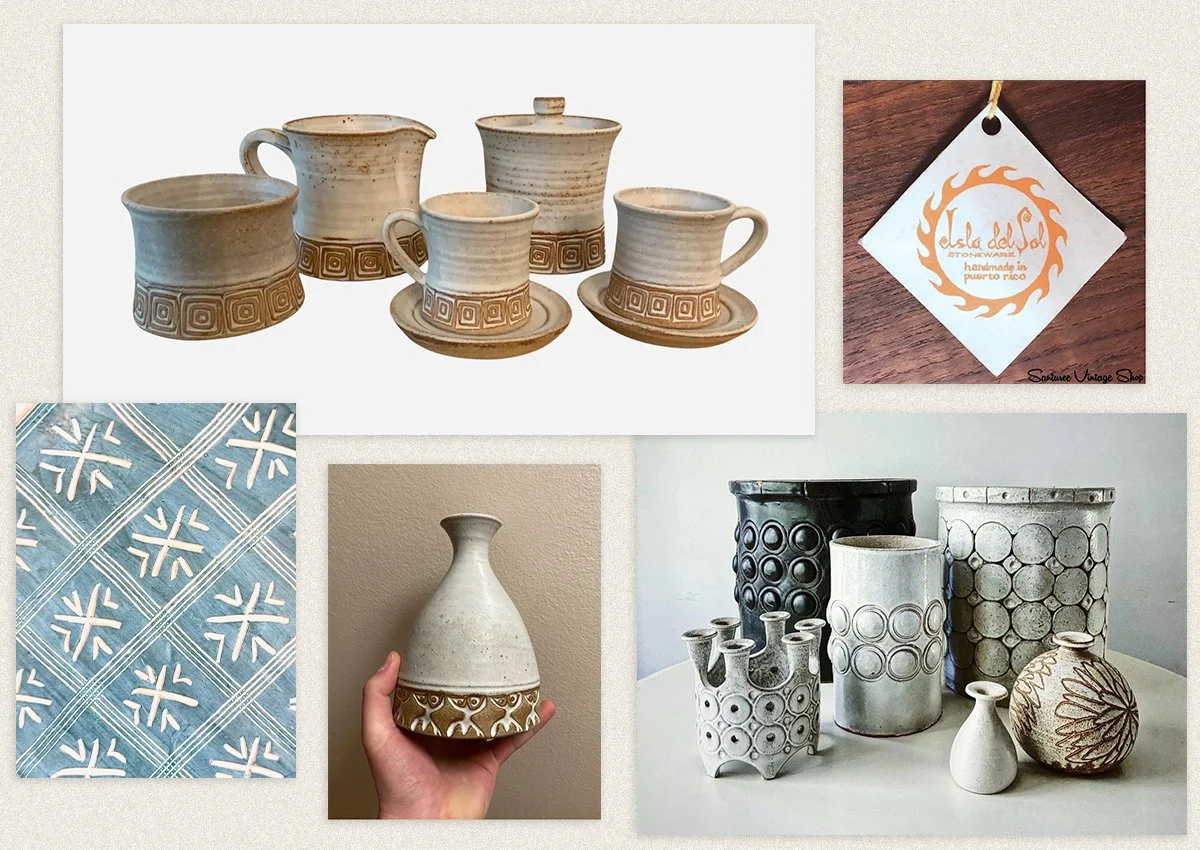
Images, starting from the top left and moving clockwise: Coffee set attributed to Los Artesanos; an original tag included with pottery by the group Isla del Sol; collection of pieces attributed to Isla del Sol; Vase attributed to Los Artesanos; Pattern detail from a dish.

A government program meant to bolster production and manufacturing in PR hired Hal Lasky to train ceramicists, some of whom went on to form different pottery groups. Lasky pushed his trainees to ditch the rote, touristy designs flooding the market and to develop their own artistic voices.

What resulted was a sgraffito technique, patterns scraped away from the clay’s surface that played with contrasting colors. As the artists’ work developed, their patterns ended up echoing more and more the petroglyphs found across the island and left by the indigenous Puerto Ricans, the Taino. The resulting pottery ended up blending mid-century design with symbols and designs intrinsic to the island’s history.
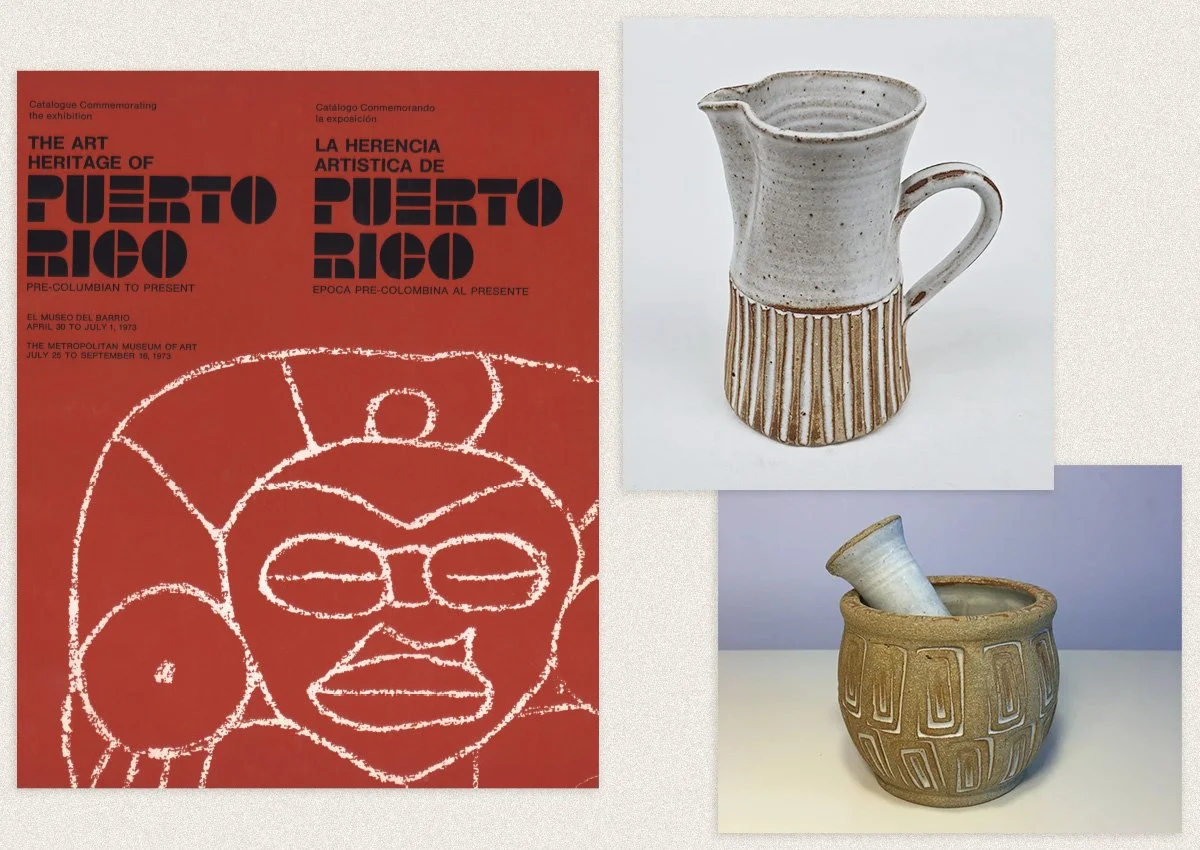
Cover of “The Art Heritage of Puerto Rico: Pre-Columbian to Present” by The Metropolitan Museum of Art and El Museo del Barrio; Pitcher attributed to Los Artesanos and Puerto Rican Pottery; Mortar and pestle, source unknown.

Each piece has a character that can only result from being worked by human hands, and the sgraffito technique meant that the results were often a surprise. I love that this blending of technique and context lead to something distinctly Puerto Rican.

The inclusion of that bowl in Diasporican feels like a deep cut, a quiet reference to the style and craftsmanship that can be found in Puerto Rico if you take the time to look hard enough.

Embracing My Roots

Culture, Inspiration, On a Personal NoteSara GoldenComment

It comes as a surprise to most people when I tell them I’m Puerto Rican. And although Puerto Ricans aren't immigrants (we're the US citizens everyone forgets about) I fell into that stereotypical 2nd generation immigrant phenomenon: wanting to be more like the people I grew up around (white, middle-class suburbanites) than my parents (thick-accented, loud-laughing, unapologetic Puerto Ricans).

Why did it take so long for me to realize that trying to be like everyone else is dumb? In trying to fit in, I lost touch with the incredible foods and flavors distinct to Puerto Rican cuisine, I wore neutral colors and silhouettes because “that’s what chic NYC people do, right?," and I missed so many chances to get to know people better because of how little Spanish I could speak.

It's Not the Holidays Without Coquito

On a Personal Note, CultureSara GoldenComment

Image via Goya, whose ingredients you’ll mostly be using for this tasty drink.


As a Puerto Rican, it doesn’t feel like the holidays if I’m not snacking on turrón (a slab of almonds with a hard nougat holding it all together), having perníl (slow-roasted pork shoulder rubbed in seasoning) for Christmas Eve dinner, and drinking as many bottles of coquito (a sweet, creamy drink comparable to eggnog) as I dare.

Every Puerto Rican has their own recipe for coquito and will swear that every other recipe is incorrect/ridiculous. I’ve seen recipes that call for eggs (what?!) or orange liqueur (absolutely not), but why mess with my mom’s version when it’s better than the rest and sooo much easier to make?

Try your hand at her version below (with a few notes, specifically about measurements because she’s notoriously vague about amounts):

Susie’s Coquito

Ingredients

  • 1 12oz. can of evaporated milk

  • 1 14 oz. can of sweetened condensed milk

  • 1 15 oz. can of cream of coconut (Coco Lopez is her brand of choice)

  • A splash of vanilla extract (or 1/2 tsp, to be more exact)

  • White Bacardi to taste (anywhere from 1/2 cup to 1 cup)

Directions

  • Mix all the ingredients in a blender, starting with 1/2 cup rum. If you don’t feel 🥴 tipsy keep adding rum.

  • Store in a glass bottle in the fridge and shake before serving.

Notes

My mom balked at any deviations from this recipe, though other people will add 1/4 tsp cinnamon, 1/8 tsp nutmeg, and a cinnamon stick. You’re welcome to try any of these, just don’t tell Susie cuz she doesn’t want to hear it.

Also, feel free to skip the rum if that’s not your thing. Coquito tastes delicious on its own, too.

A Sustainability Check-In

In the Studio, Culture, Behind the ScenesSara GoldenComment
"Eco Jewelry Handbook" by Christine Dhein

With the world coming alive again and Earth Day coming up on the 22nd, I’ve been thinking a lot about the environment and my role in it. I wanted to look more closely at my and my jewelry company’s environmental impact and realized that I could be doing a lot more than I currently am (and also, what have I been waiting for?)

I’d already been casting jewelry with recycled brass and silver as well as fairmined gold (fairmined is more about how we treat the people that mine the gold vs. its environmental impact, which still feels important). I’d also been using recycled paper whenever possible, including recyclable mailers and crinkle package filler made of mostly recycled papers.

…But that’s it. Embarrassing, right?

So I did some digging and asking around, picked up Christine Dhein’s “Eco Jewelry Handbook,” and started making some changes:

  • Jewelry-making requires lots of chemicals and potions — I’ve begun replacing them with more earth-friendly alternatives that are easier to neutralize and dispose of. This is especially important to me considering I live in the Catskill Watershed, an area whose water feeds the reservoirs that then feed NYC and the surrounding areas; we have to be extra careful about what goes down our drains, into the soil, and into the water.

  • Using EcoEnclose for as much of my packaging as possible, which includes fully recyclable postage stickers and mailers. Soon that will include packing tape and printed materials, too.

And in the next few months I’ll start:

  • Planting a tree for every order placed with One Tree Planted starting this month. This organization has already planted over 40 million trees, working with partners all over the world including the U.S. Forest Service here in the US.

  • Switching to bio-degradable zip bags — every piece of jewelry gets stored in its own bag, so many jewelers (like me) are drowning in them. Not knowing any better, I bought the regular ones in bulk a while ago but once I’m through my current stash I’m making the switch.

  • Reducing the paper stuff that’s included in each order, like skipping envelopes and printed invoices (but keeping gift receipts).

Have you seen other companies doing awesome things for the environment that you think I should consider, too? I’ll readily admit that I’ve got a lot of room for growth, so if you’ve seen something please do share!

Egyptian Asps

Inspiration, CultureSara GoldenComment

Watching the incredibly glamorous and over-the-top Cleopatra, starring Elizabeth Taylor, sparked something in my brain. The costumes! The culture! The love story! Though much of it was 1960s Hollywood applying its shiny veneer to history, I wanted to know more about this woman, Egypt’s final ruler, and all the stories we still tell about her.

Image credits, clockwise from top left: Snake rings from The Metropolitan Museum of Art’s collection; Elizabeth Taylor in Cleopatra; Snake bracelet from Phoenix Ancient Art’s collection; Detail of “Death of Cleopatra” by Francesco Cozza; Illustratio…

Image credits, clockwise from top left: Snake rings from The Metropolitan Museum of Art’s collection; Elizabeth Taylor in Cleopatra; Snake bracelet from Phoenix Ancient Art’s collection; Detail of “Death of Cleopatra” by Francesco Cozza; Illustration from John Edwards Holbrook’s “North American Herpetology”

Most tragically, her final story is one of star-crossed lovers meeting their end. She and Marc Antony, co-ruler of the Roman empire back in 30 BC, fell in love and joined forces against Octavian, Rome’s other co-ruler and eventual emperor. When Octavian’s forces defeated Marc Antony’s in a civil war, she and Marc Antony made a pact to end their lives instead of submitting to a new ruler. Marc Antony acted first, and upon hearing the news Cleopatra locked herself in a tomb with her two maids, using an asp’s poisonous bite to end her life.

Painters, sculptors, and playwrights have depicted Cleopatra’s life, with asps prominently featured every time. These snakes are especially meaningful considering how important they were in ancient Egyptian culture, represented by the goddess Wadjet and symbolizing a pharaoh’s divine authority. Worn as talismans, they were said to grant protection and health. Snakes have been important in other cultures, too, featured in creation myths, symbolizing rebirth and new beginnings, and said to bring good luck.

Left: Asp Bangles and Asp Rings from our Egyptian Asps Collection; Right: Snake bracelet from the Egyptian Museum in Cairo, photo by Kenneth Garrett

Left: Asp Bangles and Asp Rings from our Egyptian Asps Collection; Right: Snake bracelet from the Egyptian Museum in Cairo, photo by Kenneth Garrett

What started as an obsession with Cleopatra turned into an urge to make this ancient symbol into modern, wearable amulets. I hope you enjoy wearing these new versions from our mythically-inspired Egyptian Asps collection.